
Content planning and funnel
How to Build Expert Content From Personal Story and Expertise

A step-by-step guide to turning your own story and your professional knowledge into content that sells, using audience beliefs, proof and funnel stages. It covers what to post, why each post exists, and how to sequence posts so trust turns into inquiries.
Analyze your brand, competitors and audience, then approve ideas before posting.
Personal story and expertise sell together and fail apart. Story proves you understand the reader's situation. Expertise proves you can fix it. Build the section around the beliefs a buyer has to change before they hire you, then write one story post and one expertise post for each belief.
Why this matters
People do not buy because they learned more. They buy because they changed their mind. They stop believing they can figure it out alone, or they stop trusting the approach they have been using.
That is why most expert blogs stall. Story-only content gets likes and no inquiries, because a story tells people who you are and nothing about what you can do for them. Expertise-only content gets respect and no purchase, because any competent person in the field could have written it.
The fix is sequencing. Each post does one job: create reach, move one belief, or ask for the sale.
The funnel in three stages
What the reader does: Follows you.
Metric: Reach, new followers. Share of content: 30%.
What the reader does: Starts believing they need this, and that they need you.
Metric: Comments, saves, DMs. Share of content: 60%.
What the reader does: Buys.
Metric: Inquiries, sales. Share of content: 10%.
Personal story and expertise both live in the warm-up stage. That is the 60% where most content plans are vague.
The rule for using your own story
The client is the hero and you are the guide. The reader has to recognise themselves in your story rather than admire you. A story with no professional decision inside it is biography, and biography does not convert.
Three places a personal story earns its slot:
- As the opening of a decision, at the moment you were uncertain
- As the origin of a rule you now follow
- As proof that a tradeoff cost you something real
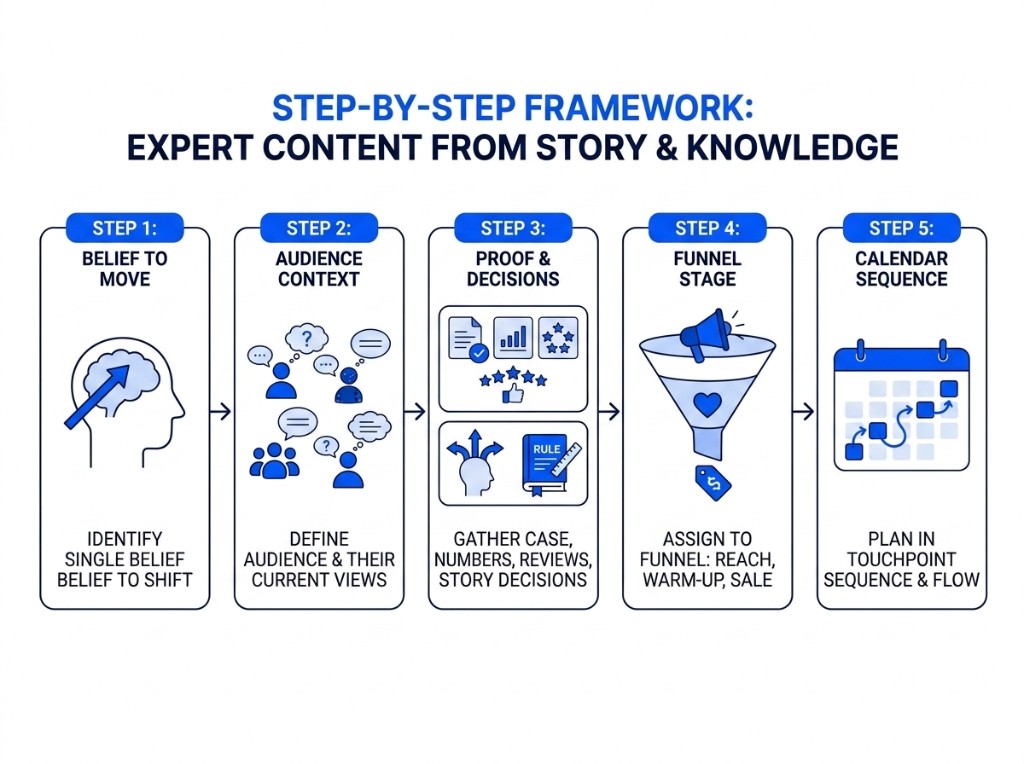
A simple framework
| Step | What to decide |
|---|---|
| Belief | Which single belief this post has to move |
| Audience | Who the post is for and what they already think |
| Proof | The case, artifact, number, review or decision that backs it |
| Funnel stage | Reach, warm-up or sale |
| Calendar fit | Where it sits in the sequence of touchpoints |
The belief map
This is the core of the section. Fill it in once and every warm-up post comes out of it.
| What the client thinks now | What they should think after | Story post | Expertise post |
|---|---|---|---|
| "I will figure it out myself, it is all online" | "There are things I cannot see on my own" | I spent a year doing this from online guides. Here is what I had to redo. | Three mistakes I see in everyone who assembled this themselves |
| "All these specialists are the same" | "This one works differently" | Why I stopped working the way my industry works | How I choose between option A and option B, and why not the way everyone else does |
| "This is expensive" | "Doing nothing costs more" | A client came back six months after our first call. Here is what happened in between. | What six months without a solution costs, in numbers |
| "My case is special" | "They have worked with people like me" | The story of a client who looks exactly like my audience | Three types of situations, and the one where my approach does not work |
| "Now is not the time" | "Now is exactly the time" | What I postponed for two years and what it cost me | The signs that you can no longer postpone this |
| "Even if it works, I will not pull it off" | "The process is clear and I will be guided" | What the first week of working with me looks like from the client's side | My method step by step: the input, the stages, what you get at each one |
| "They talk more than they do" | "They are a practitioner, here is the work" | What I did with my own hands this week | A fragment of a working document and why it is built that way |
Story topics that sell
- The turning point: the project after which I stopped working the old way
- A failure and what it cost me, with the number
- The time I got the diagnosis wrong, and how I check for it now
- Why I turned down a client who was ready to pay
- Where I started and what I would tell myself three years ago
- How I made a decision when the data was not enough
- The sentence a client said that changed my product
- What I gave up on purpose to get the result
- My normal working day with the nice cover removed
- What I stopped promising clients, and why
Expertise topics that sell
- How I diagnose: three signs of the real cause
- My method step by step, and what the client gets at each stage
- The rule I use to pick strategy A or strategy B
- What my approach deliberately does not solve
- A case: point A, constraints, the decision, the metric, the timeframe
- Working through a follower's problem out loud
- An artifact: showing a working document and explaining its logic
- Counter-thesis: the popular advice in my field that does not work
- A breakdown of someone else's example and why it is strong
- How I check the result before handing it to the client
How it adds up to a month
At eight posts a month:
- 2 reach posts
- 5 warm-up posts: 2 stories, 3 expertise, each closing one belief from the map
- 1 sale post
Order matters. Start with "I will figure it out myself" and "everyone is the same," then price and timing, and finish with "I will not pull it off." That last belief sits directly before the sales post.
Examples to use
Use this as a starting point, then adapt it to your offer, voice and proof.
Use this as a starting point, then adapt it to your offer, voice and proof.
Use this as a starting point, then adapt it to your offer, voice and proof.
How AI Posts Generator helps
AI Posts Generator is built for strategy-first planning. You fill in a form about your brand, and the analysis runs in one pass instead of a chat back and forth.
- An express brand-strategy audit finds your positioning, proof and content gaps
- Ideas are generated per funnel stage: reach, warm-up, sale, seasonal and trends
- Warm-up ideas come attached to the belief they move, so the sequence holds together
- You approve the best ideas before they reach the final list and the calendar
- One strong idea gets repurposed across Instagram, Telegram, TikTok, LinkedIn or X
Build a strategy-first content plan
AI Posts Generator turns brand context, website analysis, competitors and social data into a structured plan, then helps you approve and generate posts from it.
Start building your content plan